Photography as Listening: A Conversation About Come Get Your Honey
Photographer Samet Durgun on listening more than seeing, and making the photobook Come Get Your Honey in Berlin. Full talk and notes.
Or watch on YouTube.
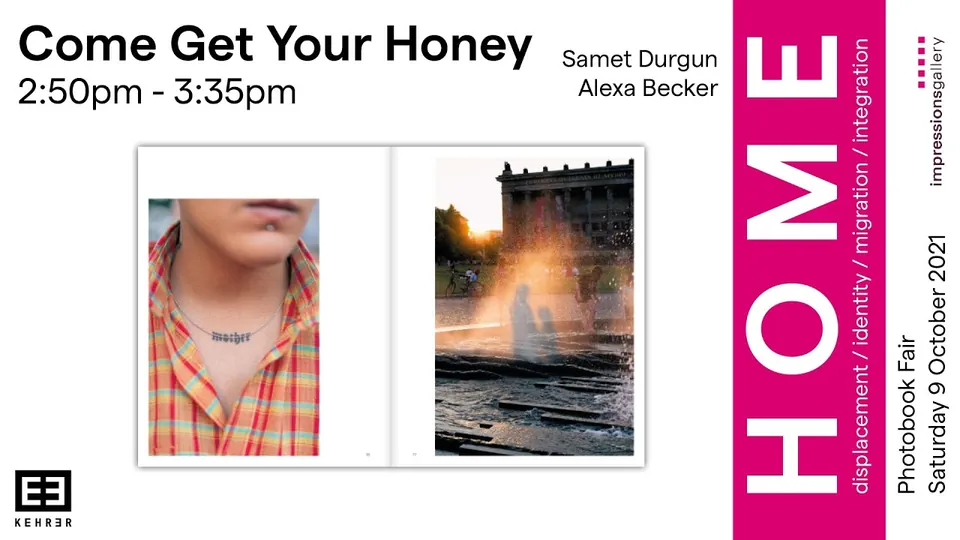
In October 2021, Impressions Gallery in Bradford invited me to their annual Photobook Fair to talk about the photobook Come Get Your Honey with Alexa Becker, the commissioning editor who worked on the book at Kehrer Verlag. The full recording is above. What follows is a set of notes on what we covered, for anyone who would rather read than watch. Below the notes is a full transcript of the conversation.
The fair that year sat alongside an exhibition called In Which Language Do We Dream, a project about a Syrian family and about identity, displacement and belonging. It was a fitting room to be in.
The question underneath the book
The book began with a question I could not put down. What if photography is more about listening than seeing?
Photography usually pulls attention toward the visible: accuracy, metaphor, composition, surface. That focus makes images easy to consume quickly and then forget. Listening moves the attention somewhere else, toward the who and the why. It asks who is holding the camera, and what their background, position and reason for being in the room are. It asks whose gaze the picture serves, and whether the work interprets a person or only makes them look good.
That last distinction is the one I keep returning to. Beautifying someone is not the same as understanding them. I later wrote the idea up as an essay, Photography’s Quiet Revolution: Seeing Through Listening.
Who the book is with
The Come Get Your Honey series was made with LGBTQIA+ refugees and asylum seekers living in Berlin.
The two words are not interchangeable, and the talk spends time on the difference. An asylum seeker is still inside the process of seeking protection. A recognised refugee has been granted legal status and residency. Among the people in the book, some were still waiting on a decision; others already had that status. The gap between those two positions shapes almost everything about a person’s daily life, including how visible they can afford to be. What Come Get Your Honey is and who it involved sets out the difference at more length.
The connections that made the work possible formed the way connections usually form, through people who already knew each other. Prince Emrah, a performer and the founder of a collective supporting queer refugee and asylum-seeking artists, was one of the first.
Berlin as pockets of freedom
Some of the pictures are portraits and some are of the city. Putting them next to each other was a way of holding two things at once.
Berlin has a real tradition of openness. It also has streets where that openness does not reach. The word I used in the talk was pockets. Berlin offers pockets of freedom, places where people find each other and can be fully themselves. Its safety is not spread evenly across the map. Anyone who has moved through the city as a visibly queer person already knows this.
Why I made it
Gender and displacement are the visible subjects. Underneath them there was something more personal, which was a wish to get out from under old shame and old secrecy. Making these pictures was a way of being close to people I admire and love, and of saying so.
I came to photography late and sideways. I studied business, kept painting, kept taking elective art courses, and eventually moved toward photography because it offered more emotional range and more room to work. The influences that come up most for me are not only photographic. Music and literature do as much work as images.
Making the book
I badly underestimated what a book takes.
I wanted a small universe, not a portfolio. The finished object has an introduction, an outro, an interview, and QR codes that open a voice recording and a video. The foreword is by Amrou Al-Kadhi, who writes about what it means to live as a queer person at the edge of a society while also carrying displacement and the search for belonging.
A book also does something a feed cannot. It is portable, it is finite, and it lets someone move at their own speed. Images on a screen arrive and disappear. Images on paper stay where you left them.
On collaboration
Not every portrait is collaborative in the strict sense. Some are. What is constant is that the people in the pictures know what I am doing and why.
The relationship comes before the photograph. That order matters, and it is the part of the method that takes the most time and cannot be shortened. You can see where that led in the exhibitions that followed.
What listening looks like in the room, in the order things happened, is in Listening in Practice.
To bring these questions to your programme or classroom, see artist talks on photography, consent and representation for subjects, formats and enquiries.
Transcript
Lightly edited for readability from the recording above, with filler words removed and names corrected. The moderator's opening housekeeping and the reading of Amrou Al-Kadhi's foreword (printed in full in the book) are noted but not reproduced. The first chapter below is open; the rest open as you scroll, or all at once with Expand all. Each timestamp seeks the player above, and the whole transcript can be read without the video.
- Refugees and asylum seekers 9:47
- Berlin and visibility 13:54
- Why this work 18:49
- Background and influences 19:48
- Making the book 24:37
- What comes next 29:31
- Photography as listening 30:51
- On collaboration 34:10
[The talk opens with a welcome from the Impressions Gallery moderator, introducing the fair, the exhibition In Which Language Do We Dream, and the speakers. The conversation begins around 3:55.]
Alexa Becker: Thank you so much, Angela, for the nice words introducing us. Hi Samet — I'm really happy to be part of this, and I guess you are too.
Samet Durgun: Yes, absolutely. Thank you so much for this opportunity — and thank you for having me again, Alexa, after more than a year since we talked for the first time.
Alexa Becker: That's a good occasion; I remember it with a smile. First of all, I remember when I first saw Come Get Your Honey. You sent us a submission, and I saw the pictures and was immediately taken by them, because you really have a gift for portraying and showing a very complex theme — the refugees in Berlin who identify as LGBTQIA+ people, which sometimes brings a lot of tension with it. And in your beautiful book there is an amazing foreword by Amrou Al-Kadhi, and the first part of it is just so telling of what this work is about. I would like to read it — it takes one minute thirty, I checked.
Samet Durgun: Absolutely. Amrou has done a great job, and I'm really happy we have that contribution.
[Alexa reads the opening passage of Amrou Al-Kadhi's foreword, printed in full in the book.]
Alexa Becker: I think that's very moving.
Samet Durgun: Yes — and that's just the beginning of a relatively long text. I'm really lucky that Amrou agreed to contribute. The book gave me the chance to make the whole experience richer. It was about getting people together in one place, on a common ground, and Amrou's essay is a great example of how that amplified the images.
[A short pause while screen-sharing is set up.]
Alexa Becker: Why don't you tell us a little about the people you photographed, and why — and do you belong to the scene you photographed?
Refugees and asylum seekers
Samet Durgun: The people are the queer refugees and asylum seekers who happen to live in Berlin. And there is a difference, maybe for the audience, between refugee and asylum seeker. Asylum seekers arrive in a country and seek asylum — that is the first step. Once you are accepted as a refugee, that is another level: you have a paper, you have a visa to stay. These two things are worth mentioning. And yes, these people are queer, transgender, non-binary — all the letters of LGBTQIA+ — and we all live in Berlin.
The short answer is that I am partially part of the community, because we are all displaced — we live in another place than our homeland — and we are all queer. That is the way I identify with the community, and connect with it, while being honest about our differences. Because of course there is a big difference: I am not a refugee, and I am not an asylum seeker. I am an immigrant in Germany who even got German citizenship.
Alexa Becker: Was that difficult for you, getting the citizenship?
Samet Durgun: It depends — even on the occupation you have. I work in the tech industry in Berlin, so as long as you pay taxes, you can apply for citizenship after some time. It had been more than eight years for me.
Alexa Becker: And were you introduced by a certain person? How did you get in touch?
Samet Durgun: There are several key people who were extremely generous with me, who were also thought leaders and opinion leaders in the community. The first is Prince Emrah, who also interviewed me for the book — a flipped interview, asking me the questions. Her pronouns are she and he. She was the first person I got in touch with. She is a belly dancer, a beauty and wellness student, a larger-than-life figure I am lucky to know and call my friend. The more time we spent together, the more people came along. She is also the founder of a collective [name unclear in the recording] that provides space for and champions queer refugee and asylum-seeker performance artists — singers, drag artists — who might have a hard time finding a stage when they first arrive. So it was an organic connection: me connecting with friends, connecting with the collective, and the whole community — community meaning people knowing each other, basically.
Alexa Becker: It sounds like a very organic development. I was really taken by the warmth of the portraits, but also by the more metaphorical images.
Berlin and visibility
Alexa Becker: This specific image is very touching — you see the shadows of the people in the spray of water, and I think it says a lot about visibility versus invisibility, and how these people are moving around in our society. Is it a little like that?
Samet Durgun: Everybody who looks at this picture takes what they take, and that is the beauty of images — I cannot force a meaning onto it. The only thing I can do is feel that this is the picture that fits the feeling, or the theme, in my mind. But this is a figurative image, so to say. There are more city images, in the book as well, because this book is about people — but also about people who live in a certain city. That is why it was important for me to observe the city, to collaborate with people in the city, and to make these images that are from the city.
Alexa Becker: An image pair that particularly speaks to me is this torso — warm and welcoming, with this amazing red colour, so soft — placed next to this building. That is what I associate with Berlin too: it is a big city, a tough city, not charming all the time, and the weather is not super nice most of the year. What is life there, from your perspective and from the refugees' perspective?
Samet Durgun: It is really interesting how we look at these two images and how many different meanings they can hold. For me, when I see them next to each other — which is how they appear in the book — I think that this person I know, Suryani, is like a rock. That is where this pairing came from: she is a rock to me. But it is fair to say everybody's life is different in Berlin. Some love it; all of us realize it is not the perfect city. But the comment I heard from people, many times, is that it is definitely better than where we came from — in terms of gender expression, feeling comfortable with your gender. Obviously it also has its own unique challenges.
Alexa Becker: Berlin has this very long tradition of being super open — you can be who you want to be there. There is a lot of openness and tolerance, or people simply do not care. It is certainly a very special city.
Samet Durgun: To build on that: somebody would not be openly harassed, let's say, walking in the street. But I would say the freedom of Berlin — the beauty of Berlin — comes from the fact that there are pockets of freedom that everybody can connect to. If you belong somewhere, or want to belong somewhere, you go and find those people. That diversity, what it can offer you, is the most important thing Berlin offers to LGBTQIA+ people. Not that it is really, really safe — not that everybody feels super safe in the streets or at night — but more that we know we are not alone. We are together, if we want to be.
Why this work
Alexa Becker: When you came to Berlin, was it clear to you that you would focus on the subject matter you did — on gender?
Samet Durgun: When you look at the book from a fair distance, yes, I can say gender is the main topic. But when I think about how these images came together, and why I made them, there is this part of me setting myself free from the shame that I had, from the secrets I had to keep. And there is the aspect of connecting with people — finding people whom I adore, I aspire to, I love. There is as much about connection in this book as there is about gender or displacement.
Background and influences
Alexa Becker: What I find interesting is that you had a life before photography. You started an entirely different career, and then you became a photographer — and successful really quickly. You have this book, an exhibition at the Museum für Fotografie in Berlin, which is not where you usually start. What brought you to photography?
Samet Durgun: That is a great question, and sometimes I try to answer it for myself. I think there is a part of me which always belonged to art. Taking pictures of my sister — consciously setting up stages, making my friends look good, taking pictures they liked. I was making paintings in high school while people had their lunch breaks; I was taking all the available art classes at my liberal university in Istanbul while I was enrolled in business. So art was always part of me, and I never really thought it could be something I would do professionally. It occurred to me after a couple of years of living the business life and still missing the depth — the emotions, the complexity, the freedom I was searching for. Photography and art were always with me; they just sprouted.
You mentioned this swift success — the book, thanks to talking with you, and the museum. I see these as the little leaves of a small sprout: there is so much rooting in the soil, and what we see is just the thing above the earth. It looks like everything started to happen very quickly, but that is just one part of the story.
Alexa Becker: Was there an artist, or different sources, that informed your aesthetic? You have a very consistent way of taking pictures.
Samet Durgun: I will try to keep this simple, because every time I talk about my inspirations I get lost. I feed my creativity from different art forms. The book's name, Come Get Your Honey, is a line from a song by Robyn, the singer and songwriter. There is André Aciman, the author of Call Me by Your Name, who has this positivity in him. There is Jeff Koons, there is Marina Abramović, there is Wolfgang Tillmans [?], there is Mitch Epstein — and countless beauty and fashion photographers, social portrait photographers. I am swimming in inspiration, taking the best of their bits. But visual consistency is something I am personally obsessed with — consistency in my life — and it surfaces in my images too.
Making the book
Alexa Becker: What was the bookmaking process like for you? It is entering something completely unknown — technical details, planning, paper choices.
Samet Durgun: I would say it is good that I did not know before I started. That does not mean I will not make more books — I love making books now. But as a beginner I totally underestimated how complex it is, how much effort and thought — and how many people — a book takes. I am glad we talked at the right time, maybe before I discovered how complex this thing is, so I jumped on it and grew into it. Thank you for making it sound easy, and for being so supportive from the beginning. It was a long and exciting process, and the team was extremely helpful and open to all my suggestions, even though I was doing this for the first time.
Alexa Becker: What does this book signify for you? It means different things to different people — a stepping stone in a career, or an object people fall in love with.
Samet Durgun: While I was making the images, I realized there was a deeper story I wanted to tell — a little universe I wanted to create. That required an intro and an outro: the intro from Amrou Al-Kadhi, the outro from Marianne Ager, a curator and a friend. Then the interview with Prince Emrah, who asks me the questions. And there are even QR codes where you can find sound and video — I will not tease too much — and a website where you can check the backside of some of the images. Many elements that together create a little universe. This book is as much a live object as it is an experience — for a viewer, for myself, and for the people in the pictures first.
Alexa Becker: To me a book is like a mini visit to a museum. It creates an atmosphere: you open it, you take your time, you have a little peace of mind, and you can digest its contents and let them sink in. You can pick it up, carry it, you do not need electricity. A book is really a miracle between two sheets of cardboard.
Samet Durgun: I absolutely agree. There is something I read: if you want to change someone's mind, give them a book. If you want to learn something at your own pace, a book is a great way to do it. And there is the feeling of coming back whenever you want — that does not happen with endless social media feeds, or even movies. You can keep coming back to your favourite image. There is so much more in it than two cardboards and some paper.
What comes next
Alexa Becker: Would you want to expand this body of work — a follow-up book — or is the topic done for you?
Samet Durgun: I am lucky to call some of the people in the book my friends, so we still see each other, and there are pictures coming from those meetings — I always take my camera with me. But this book is a personal book to me. It is even my coming out to my bigger family, who might not have seen the book yet. I am very connected to what I am doing in terms of images, and that is the thing I want to explore further: what is drawing my attention, what is making me think, what is making me dream. So I think there will not be a Come Get Your Honey Two — but there will, for sure, be images of people from the community, maybe Prince Emrah, that will surface in another way.
Photography as listening
Alexa Becker: It was said at the beginning that this was as much about listening as taking pictures. Can you explain that a little more?
Samet Durgun: The way I see it, today's photography — let's even put a number on it, 98 percent — is about the visuals. The visual accuracy, the metaphors and depth, the charge of an image. We are always looking at the surface; we consume it, looking at it but blindly, in a way. But there are other aspects beyond the what and the how, and I would call them the who and the why. Who is making the images — is there a connection between the photographer's ethnicity or culture and the subject? What is the socioeconomic status of the artist? We already ask those questions a lot. To me there is one more step, and that is why. With the given chances and opportunities, taking the time, being curious about this subject — why do I take these images? Whose gaze am I serving with them? Is there an additional interpretation of the subject I am dealing with, or am I just beautifying it — saying the same thing again, adding nothing? This "what if photography is listening" is about everything else but seeing.
Alexa Becker: Truly absorbing the background of why these pictures were taken and what they want to express. Thank you.
On collaboration
Moderator: Thank you for elaborating on that idea of photography as listening rather than seeing. With the portraits, how did you work with the people you were making work with — and about? Would you see it as a collaborative process? Some of the images are quite intimate and personal. To what extent did you discuss them with the people you worked with?
Samet Durgun: There was not one way of doing things — I would not say all pictures are collaborative, and I would not say all pictures are my ideas. It is a mix. But what is true is that everybody was well informed about what I was trying to do. One person who visited me after the book said: there was no way I would have said no to you, because you were so kind and direct with me about what you wanted to do — she told me she saw me as family. There was this really honest interaction between us. I did not go places to take pictures: I met people first and had relationships. That does not mean I was hiding my camera; it was more like waiting for a moment that drew both of our attentions.
There are also images that go a step further. The opening page of my website is a dance costume — a costume I borrowed from Prince Emrah, who interviewed me. It was such an organic moment that night: I wanted to dress up like Emrah and have a great picture of that. So there are also these over-collaborative images that hold an even deeper meaning for me, and I hope they transmit visually to the viewer as well.
Moderator: I think that relationship really comes through.
[Closing thanks. The moderator wraps up, notes the book is available through the Kehrer Verlag website, and the talk ends at 38:09.]